Enabling climate-resilient Sustainable Ocean Planning for the future.

ASPACE (Assisted Spatial Prioritisation Addressing Climate Effects) is an assisted spatial prioritisation software conceived to support the design and exploration of climate-resilient, socially acceptable and economically viable spatial policy scenarios.

ASPACE is designed using a knowledge co-creation process with end-users, to support stakeholder engagement, evidence-based decision-making, and research in marine spatial management.

The software outputs are spatial management scenarios of marine uses, along with their climate, economic and social scores.

ASPACE is therefore an ideal decision support tool to enable evidence-based, climate-smart:

  • Marine Spatial Planning
  • Marine Protected Area design
  • Sustainable Ocean Planning
01 ABOUT

ASPACE allows users to estimate the climate change sensitivity of regions of interest, and to explore how uses of marine space can be managed to help build climate resilience for nature and people.
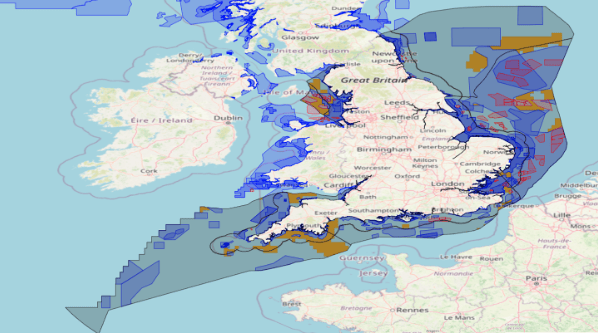
About ASPACE

Recognizing that climate-resilience is only actionable if it works for nature and people, ASPACE further estimates the blue economy effects of user created scenarios, as well as how they align with how stakeholders value marine space.

ASPACE is delivered as a free, web-based tool with a user-friendly front-end and tutorial documentation accessible to laypeople. User can use system data or upload their own data for share with the ASPACE community, or for private use.

ASPACE is already helping design marine spatial policy today. As the ASPACE community grows, we hope to support a more sustainable ocean future, for nature, people and our planet.

01

  • Upload or select ocean climate datasets from the ASPACE database.
  • Estimate the climate change sensitivity of a region of interest for specific marine activity sectors (e.g. small-scale pelagic fisheries) or ecosystem components (e.g. benthic habitats).

02

  • Visualise and explore ocean climate modelling data analysis outputs.
  • Compare analysis results with the current or future distribution of key marine sectors, administrative boundaries, and/or key species and habitats.
  • Collect stakeholder values on marine space.

03

  • Create alternative spatial management scenarios to strengthen climate change resilience in a region and sector(s) of interest.
  • Compare alternative spatial management scenarios by considering their overall use of climate-resilient areas, their impacts on the blue economy, and their alignment with stakeholder values for marine space.
  • Download analysis and visualisation outputs.

02 TEAM

Our team is made up of a diverse range of researchers, working in a range of disciplines, from early career scientists to those with decades of experience.

Professor Ana M Queirós
Climate Change Lead at Plymouth Marine Laboratory / Honorary Professor at the University of Exeter
Bio: Ana is ASPACE Lead and Climate Resilient Ocean Planning expert. Ana's research focuses on ocean-based climate adaptation and mitigation.
Dr Liz Talbot
Dr Liz Talbot
Marine Ecologist at Plymouth Marine Laboratory
Bio: Dr. Liz Talbot is a marine ecologist who studies how climate change and human pressures threaten marine life as part of PML’s Climate Smart Ocean Management team.
Professor Gina Yannitell Reinhardt
Professor of Government and Founder, ARISE Initiative (Advancing Resilience and Innovation for a Sustainable Environment) at University of Essex
Bio: Gina assesses stakeholder values, preferences, and acceptability assessments.
Dr Alberto Roca
Dr Alberto Roca
Alberto is an Assistant Professor at the University of Valencia and an Associate Researcher.
Bio: Alberto is an applied economist specialising in environmental and marine economics, focusing on economic impacts of climate change, fisheries management, and sustainability policies.
Dr Stefanie Broszeit
Marine Ecosystem Services Researcher (Marine Ecology & Society) at Plymouth Marine Laboratory
Bio: Stefanie is a senior ecosystem services scientist, and has provided evidence for links between species in the model and the ecosystem services they provide.
Dr Océane Marcone
Dr Océane Marcone
Social Science Research at Plymouth Marine Laboratory
Bio: Océane has been working on stakeholders' preferences elicitation
Professor Simon Mair
Lecturer in Sustainability, Department of Environment and Geography, University of York
Bio: Simon is an Ecological Economist, interested in understanding the current economy in order to build something better.
Stefano Marra
Stefano Marra
Senior Marine Ecosystems Scientist at JNCC
Bio: Stefano is a benthic ecologist developing indicators to assess marine benthic habitats and supporting marine biodiversity reporting.
Luz Rodriguez
Luz Rodriguez
Research and Impact Services at Plymouth Marine Laboratory
Bio: Luz delivers research and impact support services.
Mohammad Shafiul Azam Khan
Senior Digital Research Infrastructure Engineer at Plymouth Marine Laboratory
Bio: Mohammad works on digital infrastructure engineering and software engineering for the ASPACE tool.
Dr Ben O'Driscoll
Dr Ben O'Driscoll
Research Software Engineer at Plymouth Marine Laboratory
Bio: Ben works on software engineering for the ASPACE tool.
Hugh Edwards
Hugh Edwards
Marine Planner in the Department for Agriculture, Environment and Rural Affairs (DAERA)
Bio: Working as a marine ecologist and marine planner in the Department for Agriculture, Environment and Rural Affairs (DAERA), with research interests in marine biodiversity, invasive species, sustainable fisheries, marine spatial planning, and marine climate change effects.
03 PUBLICATIONS

Key scientific publications and research outputs supporting the development and application of the ASPACE Tool are presented here.

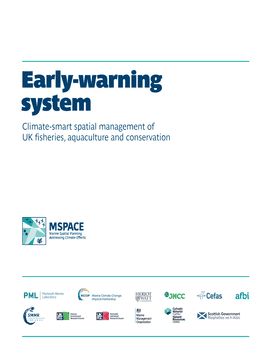
Early-warning system: Climate-smart spatial management of UK fisheries, aquaculture and conservation. A report of the NERC/ESRC Marine Spatial Planning Addressing Climate Effects project. 58 pp. doi.org/10.14465/2023.msp02.tec
Read More

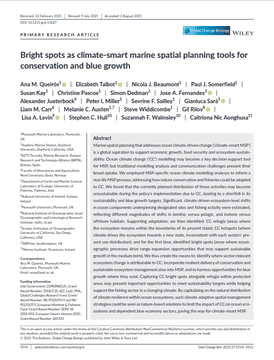
Bright spots as climate-smart marine spatial planning tools for conservation and blue growth. Global Change Biology doi.org/10.1111/gcb.15827
Read More

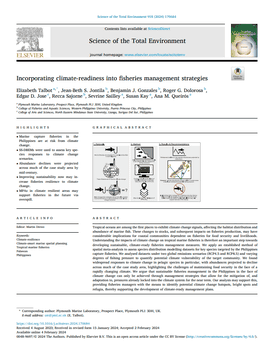
Incorporating climate-readiness into fisheries management strategies. Science of the Total Environment doi.org/10.1016/j.scitotenv.2024.170684
Read More

04 FAQs

Frequently asked questions about ASPACE.

Frequently Asked Questions

To create an account, click Sign Up on the ASPACE login page (https://mspace.ac.uk/signup/) and complete the registration form with your name, email address, organisation, and country.

Once submitted, you will receive an email to verify your email address and activate your account. The ASPACE Tool is open for users to register directly; however, access to specific datasets or features may depend on project or administrator permissions.

If you do not receive the verification email within a few minutes, please check your spam or junk folder first. If the email is still missing, contact the system administrator at aspace@pml.ac.uk.

To sign in, go to the ASPACE login page (https://mspace.ac.uk/login), enter your registered email address and password, and click Sign In.

After entering your correct email address and password, a Two-Factor Authentication (2FA) verification email is sent to your registered email address. You must enter the one-time verification code from this email to complete the sign-in process.

Two-Factor Authentication (2FA) adds an extra layer of security by ensuring that only authorised users can access an account, even if a password is compromised.

If you do not receive the 2FA email, please check your spam or junk folder first. Wait a few minutes and try again, and ensure your email inbox is not full. If the issue persists, contact the system administrator at aspace@pml.ac.uk.

You can download the full ASPACE User Guide as a PDF here:

ASPACE User Guide

You can download the full ASPACE Terms & Condition (Permission to use content) as a PDF here:

ASPACE Terms & Condition (Permission to use content)

You can download the full ASPACE Privacy Policy as a PDF here:

ASPACE Privacy Policy

If you need help with the ASPACE platform or have general support queries, please contact the system administrators at aspace@pml.ac.uk.

For copyright or legal concerns, please contact legal@pml.ac.uk.

You can also raise a support ticket directly through the ASPACE platform at https://mspace.ac.uk/create-ticket .


05 Our Partners

Trusted by leading organizations worldwide

Our Partners & Funders

The development of this ASPACE Tool is led by Plymouth Marine Laboratory.
ASPACE works with government bodies, research institutes, and conservation organizations to deliver data-driven marine spatial insights.